|
|||||||||||||||||||||
|
Peacock Revolution ('60s,'70s)
|
19th Century Origins
The interesting irony of formal attire is that almost without exception, every aspect of the masculine evening costume derives from the sport of horseback riding. Elegance: A Quality Guide to Menswear • Basic Black
The tradition of
dressing up after dark has existed for centuries. Perhaps the
most obvious evidence of this is the theater’s “dress circle”, a
term derived from the 18th and 19th century
grand European opera houses which restricted this exclusive seating section
to patrons who were properly attired.
However, the definition of what constituted “dressing up”
underwent a dramatic change about three hundred years ago.
Basic
Prior to the late
1700s men’s fashion in
George “Beau”
Brummell (1778-1840) was a middle-class Englishman with social
ambitions well beyond his income.
Because it was impossible – and unacceptable – for a man of
his station to mimic the extravagant garb of the ruling class
Brummell devised a bold solution: change the rules.
Through his influence on his good friend the Prince of
Wales, the consummate dandy was able to convince the aristocracy to
reject the ostentatious fashions of the time in favor of solemn
colors, superb tailoring and meticulous attention to detail.
Brummell’s fashion revolution would
have a profound
impact on menswear in
BlackThe philosophy of restraint and understatement in masculine attire was then taken to its furthest extent when the popularity of dark colors evolved into a preference for ebony. According to menswear historian James Laver, this trend was due to English politician and novelist Edward Bulwer-Lytton (1803-1873) who wrote in his 1828 novel Adventures of a Gentleman that people must be very distinguished to look well in black. Not surprisingly, would-be dandies across the country viewed the author's statement as a sartorial dare and quickly took up the challenge.
The popularity of wearing black
continued to
increase during the reign of Queen
Another significant influence was the solemn Protestant movement of the time which menswear authority Bruce Boyer explains led to a world in which somberness was preferred to ostentation by those “who wanted to appear as grave and serious as the banks and factories they owned.” Writer John Moore offers a more cynical view of what he terms the “mock Puritan ‘modesty’” of Victorian Society when he states that "Instead of wearing their wealth, rich men now found it convenient to display it on their wives, in the form of gowns and jewels, while adopting a kind of uniform so subtle that rank was not openly displayed. You had to know who was who by right of being an insider in society."
Whether or not the intention was elitist, the resulting formal “uniform" was most definitely egalitarian. The idea of the gentleman had trumped the idea of a courtier, leading Tailor and Cutter to declare in 1878, “Dress in our day has ceased to be the index of man’s social position.” And while black would eventually fall out of favor for day wear, it would remain de rigeur after six o’clock for the next century. • Victorian Evening WearIn his book The Suit: A Machiavellian Approach to Men’s Style, Nicholas Antongiavanni explains that the English practice of dressing for dinner originated on country estates where men spent much of the day on horseback and did not wish to bring the smell of animals and sweat inside. “So men changed clothes before coming to the table," he explains, "and this practice, because of its elegance, spread to the cities, then to the Continent, then to the haut monde.” The Victorian gentleman’s evening outfit was
essentially a black version of military dress uniform of the time,
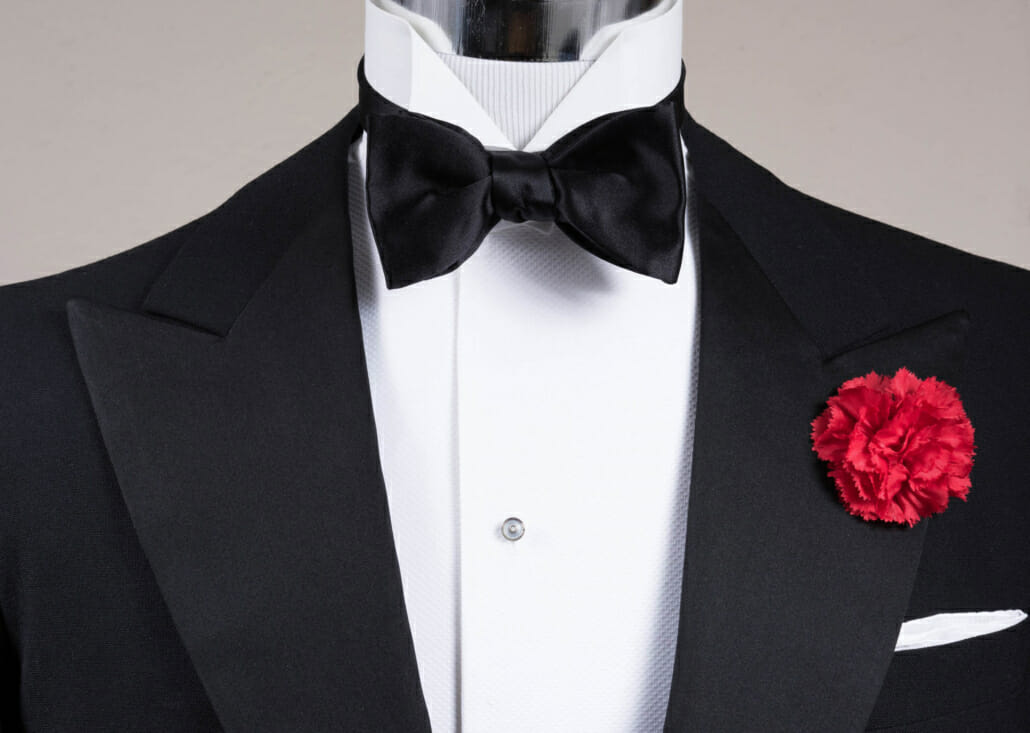
the outfit we now call “white tie”. Since the 1860s it consisted
(and still consists) of a silk-lapelled tailcoat cut away across the
waist, matching trousers which retained a military braid on the side
seams, a starched shirt with high-standing wing collar, a white bow
tie, a low-cut white waistcoat and, by the 1880s, pumps or button
boots of patent leather. The attire was pretty much identical
on both sides of the
It is important
to note that in polite Victorian society the term “evening
wear” was taken quite literally. The long tailcoat and
cardboard-stiff shirt and collar were worn each and every evening,
both in public and at one’s own home. Not surprisingly, it was
not long before upper class gentleman began to seek a more
comfortable alternative. • The Original Dinner Jacket
Just as the tailcoat had evolved from country riding attire to town day wear and finally to formal evening wear, so too did its substitute begin life on horseback. According to Boyer and Antongiavanni early Victorian country squires had their tailors fashion a shorter “lounging” jacket to replace the long frock coat for riding, shooting and everyday outdoor wear. Eventually the jacket found its way indoors when these men had it made from the same soft velvet as their dressing gowns and used it for the specific purpose of absorbing the odor of cigars that were smoked after dinner once the ladies has retired. “After this” writes Antongiavanni, “it was a short step for them to ask that it be made in black wool, with tailcoat trimmings, so that it was dignified enough to be worn in the dining room.” Society’s acceptance of this new dining jacket was assured when it was adopted by Queen Victoria’s eldest son, the Prince of Wales. Some authorities even ascribe the coat’s very creation to the future Edward VII and his penchant for elegant but comfortable clothes, either directly or through the influence of his friend Lord Dupplin. While the Prince’s role in the origin of the informal evening jacket will likely remain a matter of debate, his part in the introducing the invention to the rest of the world is undeniable thanks to a certain American dinner guest. • Introduction to America
The dinner
jacket’s introduction to American society can be traced to an 1886
summer visit to England by millionaire New York coffee broker James
Brown Potter and his actress wife Cora. Upon being introduced
to the couple at a court ball, the Prince of Wales was taken with
Cora’s beauty and invited the couple to dinner at his
Mr. Potter then brought the innovation back
home to
The truth is that the Town Topics
article has been misinterpreted. While the outfit worn to the
ball by Griswold ("Grizzy" to his friends) certainly did cause a
sensation, it was by no means a dinner jacket. An essay in the According to another essay in the village's archives, the English evening jacket was introduced to American society in a much less sensational manner more befitting of the aristocratic circles by which it would be adopted:
Eventually, after wearing the new jacket for
dinner in Tuxedo, some of the early members were bold enough to wear
it one evening at a bachelor dinner at Delmonico’s, the only place
in New York where gentlemen dined in public at that time.
Needless to say, the other diners at
Which brings us to a bone of contention for black-tie purists. Despite over a century of insistence by etiquette and sartorial experts that tuxedo is less correct than dinner jacket the truth of the matter is that the latter term did not come into existence until a couple of years after the supposed nickname did. Specifically, the Oxford English Dictionary cites the first written reference to tuxedo in the August 1889 issue of Sartorial Arts Journal while the first recorded appearance of dinner jacket is dated to a novel published two years later. The misconception about the catchy term's legitimacy likely stems from the fact that it was adopted largely by the American general public whereas the more refined dinner moniker was preferred by the American elite and, of course, the British. • Early StyleThe jacket’s other early names (see sidebar) provide some insight as to its earliest appearances. The consensus is that the original dinner jacket was essentially tailored like a single-breasted jacket of a “sack” or “lounge” suit - what North Americans now refer to simply as a suit – with a shawl collar imported from the smoking jacket and finishes borrowed from the tailcoat. The Handbook of English Costume in the 19th Century provides further details of the jacket’s formative years:
Cut like a lounge but not intended to be buttoned, so that the foreparts were narrow, with roll collar continuous with lapels turning low to two buttons, becoming one button in 1898. The back invariably cut whole and sleeves finished with cuffs (1899). The roll was completely covered with silk, satin, or velvet. Pockets without flaps (1893) . . . Materials: as for the Dress coat [at first a fine vicuna; from 1895 often replaced by a fine hopsack or twilled worsted] or of velvet. This information clearly contradicts the alternative theory put forward by some sources that the original dinner jacket was simply a tailcoat minus the tails which, as previously mentioned, means that it would have looked similar to a peaked-lapel military mess jacket. Regardless of the fact that the tailcoat’s peaked lapel did not become common on dinner jackets until the turn of the century, the undisputable fact is that both styles have enough history and pedigree to be considered “original”. • Early Etiquette
The new evening jacket caught on quickly among
the fashionable upper classes and by the late 1880s was appearing in
haberdasher publications and menswear catalogs on both sides of the The question of "when" was fairly cut and dry: the dress lounge was clearly an informal alternative to the tailcoat and as such had no place in mixed company where women continued to dress in their full evening finery. An 1896 American guide entitled The Complete Bachelor: Manners for Men provides us with the specifics of late Victorian etiquette in a passage which includes a precursor of a less formal summer dress code: The dinner coat . . . is the badge of informality. Formerly it was worn only at the club and small stag diners and on occasions when ladies were not present. Now it is in vogue during the summer at hotel hops, small informal parties to the play, at bowling parties, restaurant dinners, and, in fact, any occasion not formal. The book’s directions for "how" the coat was to be worn were equally straightforward: “Informal evening dress differs from formal in the wearing of the Tuxedo or dinner coat in place of the ‘swallowtail’, and the substitution of a black silk for a white lawn tie.” The contemporary practice of wearing either a black or white waistcoat with the tailcoat was carried over to the informal dinner jacket, with the latter color often being used to give the informal ensemble a more formal appearance. Despite the guide’s instructions, Americans frequently experimented with the tuxedo during its formative years. Besides trying out various styles and materials for the suit, they would also often borrow the white bow tie from the tailcoat ensemble which was then becoming known as “full dress”.
And so it was that the dinner jacket entered the twentieth century: an informal replacement for the tailcoat worn with essentially the same accompaniments. Its development would continue slowly during the era named after England's next monarch which began with Edward's ascension to the throne 1901 .
|
|
|||||||||||||||||||
| TOP OF PAGE |
UPDATES |
GLOSSARY |
SEARCH |
CONTACT AUTHOR
COMPARATIVE ENGLISH TERMINOLOGY Hover over images for picture credits. Copyright © 2008. Peter Marshall. All rights reserved. This site does not function correctly in Firefox |
|||||||||||||||||||||