► Bow Ties 101

Be sure to check out
the extensive information on different styles and sizes of bow
ties found on the
Classic Black Tie Neckwear page. |
| |
Formal Gift Wrapping
Think of the bow tie
as a very wide piece of wrapping ribbon that you tie around your
neck in the same fashion as you would tie a gift bow onto a
present. The only difference is that you need to take a little
extra effort to ensure that the finished bow is horizontal and
lies flat. |
| |
Look Ma, No Mirror

The best part of the
practice technique listed here is that if your bow tie is an
adjustable model, you can unclasp the finished product
then simply re-clasp it around your neck when needed. There's no need to
ever fumble in front of a mirror.
|
|
|
Alternative Technique

Steps 5 through 7 are the most
difficult simply because they involve a loop that is hidden from
view.
To help make these steps as clear as possible I have added
close-ups of this loop from an alternative view.
There is also a slightly different tying method
that brings this loop out in the open. You can see it
demonstrated in this
instructional video from an English custom tie maker.
The same technique is also shown in this
YouTube video or this
other video by two American retailers. |
|
|
The Human Touch
Don't worry about
getting the bow to look perfect. The beauty of
the self-tied model is that a personal touch is expected and
even desired. Leave the geometric precision for the
assembly-line pre-tied models. |
|
Added Bonus

Once you've learned how to tie a bow tie it opens up a whole
new world of possibilities for your regular wardrobe.
|
|
How to Tie a Bow Tie
Nothing separates the men
from the boys – and the waiters – quite like a self-tied bow tie.
And the best part is that you already know how to do it because it
is the same as tying your shoelaces.
By combining the best of many other how-to guides with a
little-known haberdasher's trick that reduces the whole process to
child's play, the instructions below provide everything you need to add
the ultimate panache to your black-tie ensemble.
Getting Started
|
|
|
If you have an
adjustable model, insert the hook on one end of the strap
into the slot on the other end corresponding with your neck
size.
If your shirt has a
turndown collar, flip the collar up just as you would before
tying a long necktie.
If your shirt has a
bow tie loop (see Black
Tie Shirts), remember to slip the tie through the loop
before starting.
|
The Practice Technique
As mentioned, a bow tie is
actually tied just like a shoelace (or gift bow) so the sooner you
can visualize that concept the sooner you'll master the technique.
This sounds simple enough except that shoelaces are not tied under
the chin; a knot easy enough for a child to tie becomes a very
different endeavor when one is forced to execute it in a mirror.
To familiarize yourself with the process without having to rely on a
reflection, tie the bow tie around your thigh instead of your neck
because it has roughly the same circumference but is situated within
your line of sight. You can use the printed instructions
below but rotate the illustrations upside down to better reflect how
the process will feel when executed under the chin later on.
Before starting you may want
to download and watch the video clip on the right to get an idea of
how the individual steps come together to create the final product
and to better visualize the more finicky of those steps.
The Standard Technique
The photographs below show
what you will see in a mirror when you follow the instructions.
Obviously, the instructions will also work if you consistently
exchange “right” for “left” and vice versa. (In fact, this is
what the model did so that the photographs would appear properly
oriented when viewed as mirror images.)
To help keep the process from appearing more daunting than it is,
the individual steps have been grouped into four key stages.
If you mess up a step, there's no need to start over from scratch
– just return to the beginning of the corresponding stage.
Tie a knot to position the tie
Form the front half of the bow
 |
4.
Fold the shorter end at the widest part of the curve (see
"Special Considerations" below). This
will create the front wings of the bow.
(Make sure the fold is on the right side of your
chest.) |
 |
5.
Hold the front in place by pinching the center of the wings
together. Pinch with your thumb and finger or your first
two fingers (see right photo on right) depending on which you find
more comfortable during the next couple of steps. |
Form the back half of the bow and knot the bow (the tricky
part)
|
 |
6.
While holding
everything in position as close to your neck as possible,
place the longer end of the tie over the front of the bow.
This longer end will form the knot between the two wings.
Note that as the longer end goes over top of the bow it also
goes over top of the thumb or finger behind the bow, thereby
forming the top of the loop that was begun in step 5 (see
close-up of loop in right sidebar). |
|
 |
7.
Use your
right hand to shove the middle of the longer end through the
loop behind the bow from your right-hand side. Obviously
you will need to retract the thumb or finger that is holding
the loop open (see close-up on right).
Advanced Tip: As you create this second knot, try to place
it directly over the simple knot you created in step 3
(which should still be tied snugly against your throat). |
 |
8. Once the longer
end is pushed far enough through that it can be released it
without falling back out (it will form a folded wing),
simultaneously pull it and the folded wing on the right side
of the front bow to tighten the knot. You have now created a
bow (albeit a very lopsided one).
Advanced Tip: If the back part of the tie is rather skewed
after being squeezed through the back loop (and it often
is), twist it so it is parallel to the front part before you
tighten the knot.
|
Finesse the assembled bow
 |
9. To finesse the
bow, hold the knot tight with one hand and use the other to
adjust the wings so that they are all an equal length.
Note: If you are using an adjustable bow tie and the
finished bow ends up with a bigger rear half than front
half, or if the neck band fits too loosely, adjust the tie
size up or down accordingly and try again. |
 |
Congratulations - you've graduated to the big
leagues!
|
Special Considerations
Folding Points
Like a gift
bow, a finished bow tie bow consists of two opposing loops and two
opposing loose ends. Unlike a gift bow, a bow tie has to be folded
over at a specific point when creating the loops in order to obtain
the distinctive "wings".
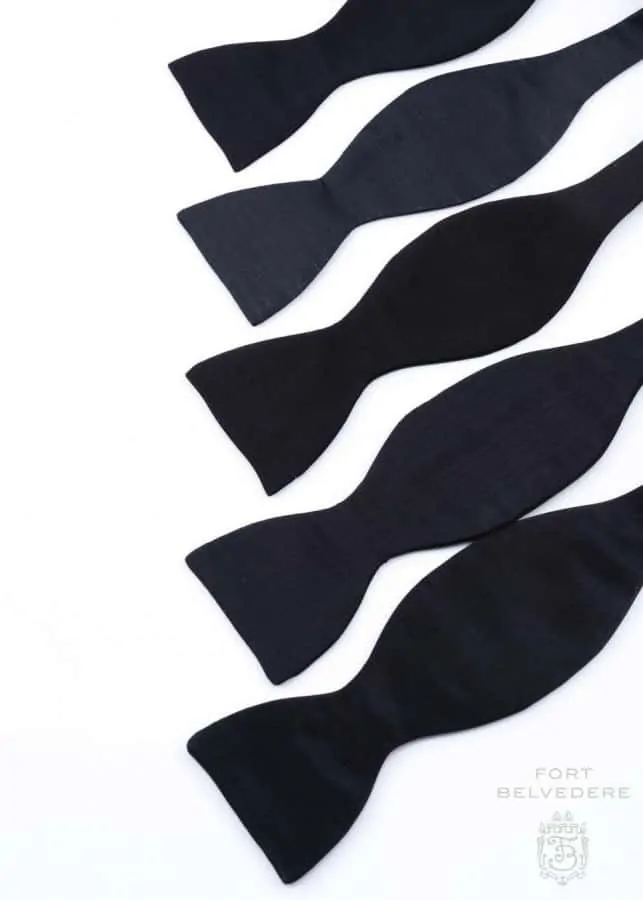
Single-Ended Bow Ties
|
Bow ties with only one shaped end allow for a tighter knot
but are very rare these days. As these
illustrated instructions from a 1960s etiquette book
show, the tying process ends after the knot is tied in step
7 – there is no need to manipulate the loose
end to create a second folded wing. (This separate
diagram shows how to tuck away the loose end into the
shirt collar.) The end result is essentially just the
front half of a regular bow. |
|

Practice Video
(8.4 MB .avi file)

Printer-friendly instructions
NOTE:
keep in mind that these are mirror images, i.e. views you would see
if you turned your RIGHT shoulder toward the mirror.


In step 5 either the
thumb or first finger is placed behind the front wings. It
must rest on top of the fabric that extends from the neck (not
underneath it) because that piece of fabric will become the bottom
half of a loop created in step 6 (and shown below).

Shown here is a close-up of the loop
that is created when the longer end of the tie is wrapped over the
front wings (and subsequently over the thumb or finger behind them) during step
6. |