Morning Wear: When a Suit Won’t Do (and a Tuxedo Shouldn’t)
Many people from around the world visit www.gentlemansgazette.com for guidance in assembling a traditional black-tie ensemble for their afternoon wedding only to discover that such attire is inappropriate for daytime functions. This comes as a disappointing shock to fiancé(e)s who have been conditioned to believe that no wedding is truly formal unless the groomsmen are clad in tuxedos. However, our European cousins know better.
Like most formal wear etiquette, the proscription against donning evening wear during the day is not simply an arbitrary custom but a matter of aesthetic logic. The tuxedo and tailcoat take their black color from their after-dark surroundings and in this context, they imbue their wearer with elegance, power and even an air of mystery. When worn in broad daylight, however, black suits look dull and lifeless and tend to make (Caucasian) men’s faces appear ashen which is what makes them so appropriate for traditional funeral director attire.
Conversely, while formal day coats are also usually black they are typically the only occurrence of ebony in morning dress (the traditional term for formal day wear). Their somberness is offset by non-matching gray trousers – which are themselves enlivened with striped or checked patterns – and by the addition of tastefully colored ties, or silver and black wedding ties, waistcoats and even shirts.
The end result is an ensemble immensely more suitable for daylight and delightfully more open to personalization than a tuxedo is, yet at the same time significantly more formal than a regular suit. It is no wonder this genteel tradition remains commonplace in Britain and at the same time perplexing that it became hijacked in America.
Basic Morning Wear Etiquette
Generally, morning dress is meant for formal affairs held in the morning or afternoon. Special considerations for weddings that begin in the afternoon and continue into the evening can be found in the Formal Evening Weddings page.
Overview of Formal Morning Dress Components
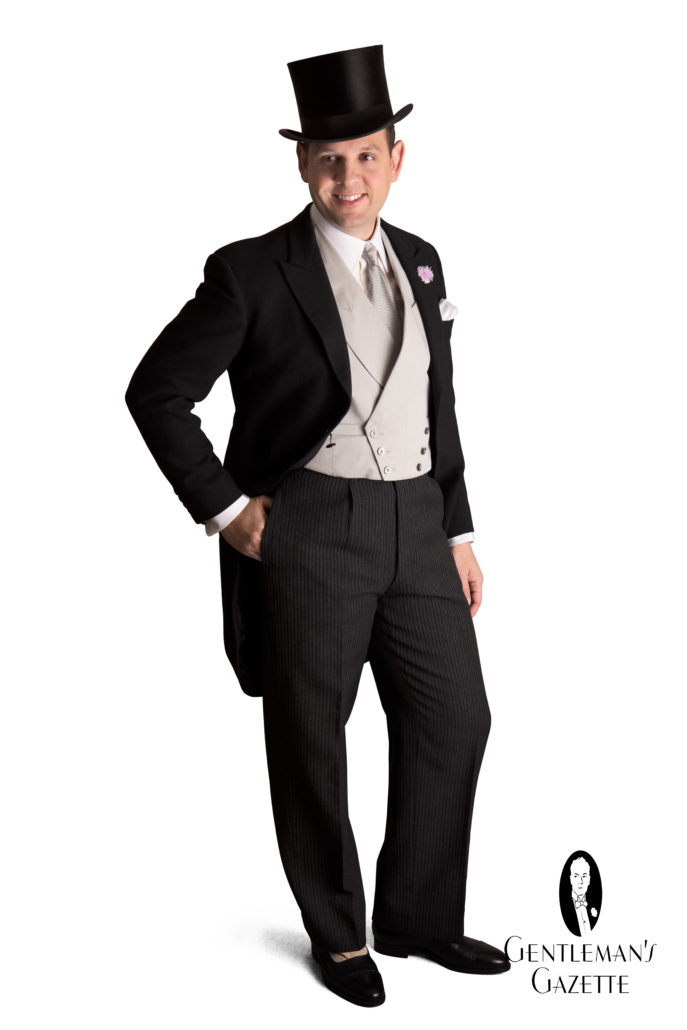
As with evening dress, there are two categories of formal day dress. The most formal version is by far the most popular and features a type of tailcoat known as a cutaway(morning coat in the UK). In Britain it is worn by grooms, groomsmen and guests at formal church weddings and for formal daytime events in the presence of The Queen such as Royal Ascot and Trooping the Colour.
In America, its appearance is largely limited to formal weddings prior to 6 o’clock and even then is extremely rare – although perfectly correct.
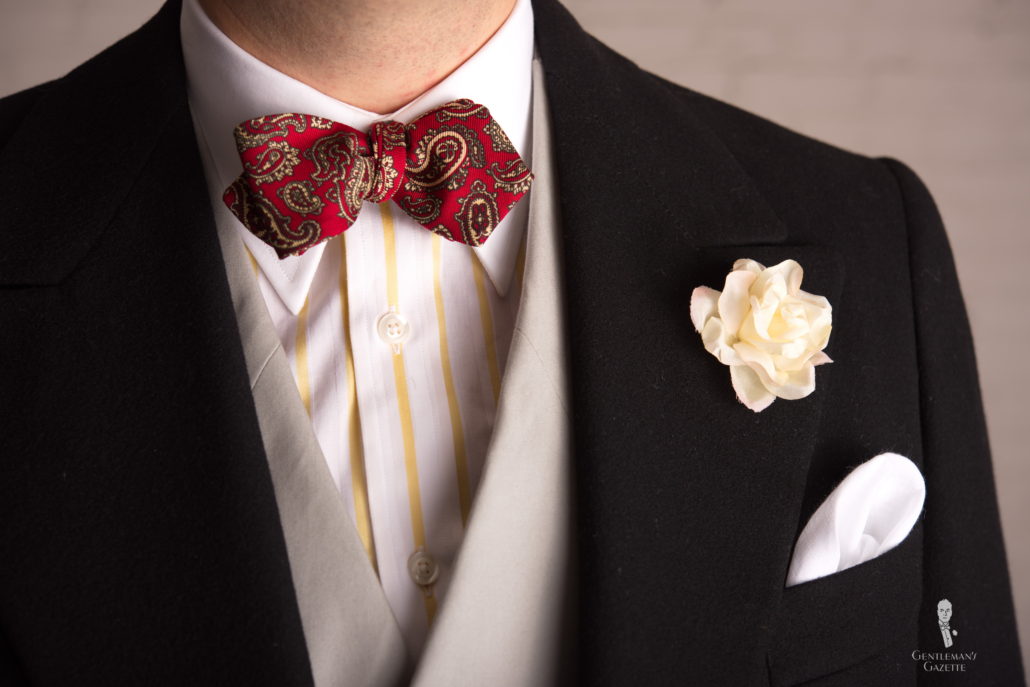
| 1. Coat (cutaway / morning coat) | Color: · black is most formal · dark gray (“charcoal” or “oxford” gray) is also acceptable Fabric: flannel or worsted wool, plain or herringbone pattern Style: · single-breasted, closing with one button or link front double button · curved cutaway front with tails that fall behind the knees · peaked lapels |
| 2. Trousers | Color: · black-striped (cashmere stripes) dark gray material is most formal · gray houndstooth, herringbone, Glencheck, or windowpane is a less formal alternative Style: · fish tail back cut for suspenders (high enough rise for waistband to be covered by the relatively short waistcoat) · one pleat down center of leg is traditional, but double pleats are acceptable too · important, morning trousers must not cuffs |
| 3. Waistcoat | Color can be: · light gray (“dove” or “pearl” gray) · creamy yellow (“buff”) · black (although Debrett’s says it is now only for mourning and certain daytime London functions) · pale colors as an alternative, such as pink, green, blue, yellow, orange etc. Model can be: · single-breasted with or without lapels · double-breasted usually with lapels · white slips are optional (a piece of white cloth attached underneath each rever that looks like piping or as if one would wear an under-waistcoat) |
| 4. Shirt | Collar: · Traditionally, a wing collar was preferred. Today, turn-down collar shirt are the norm. If you wear a wing collar today, · the collar must be the high, stiff, and detachable · it must be worn with a formal ascot · it should be white · it must only be worn with black morning coat Color: · The shirt should be white with a white collar · Or a Winchester shirt with white collar and pale color or patterned body body (cream, blue, pink, white with blue Stripes are traditional) Details: · The cuffs must be Double Cuffs / French cuffs for cufflinks |
| 5. Neckwear | Model: · wedding tie in with turndown collar · self-tie formal ascot (aka plastron, or dress cravat in the UK), worn with awing collar; not to be confused with informal day cravat / ascot Colors: · pale gray or silver in subtle patterns with black such as houndstooth, herringbone, micropattern are most traditional, especially for groomsmen hence also called wedding ties · pastel colors are acceptable alternative. Just ensure there is enough contrast to the shirt body |
| 6. Footwear | well-polished black lace-ups, capped or plain toes black button boots with cloth or suede tops are old-fashioned alternative black silk over-the-calf socks is traditional, other fine cotton socks are acceptable |
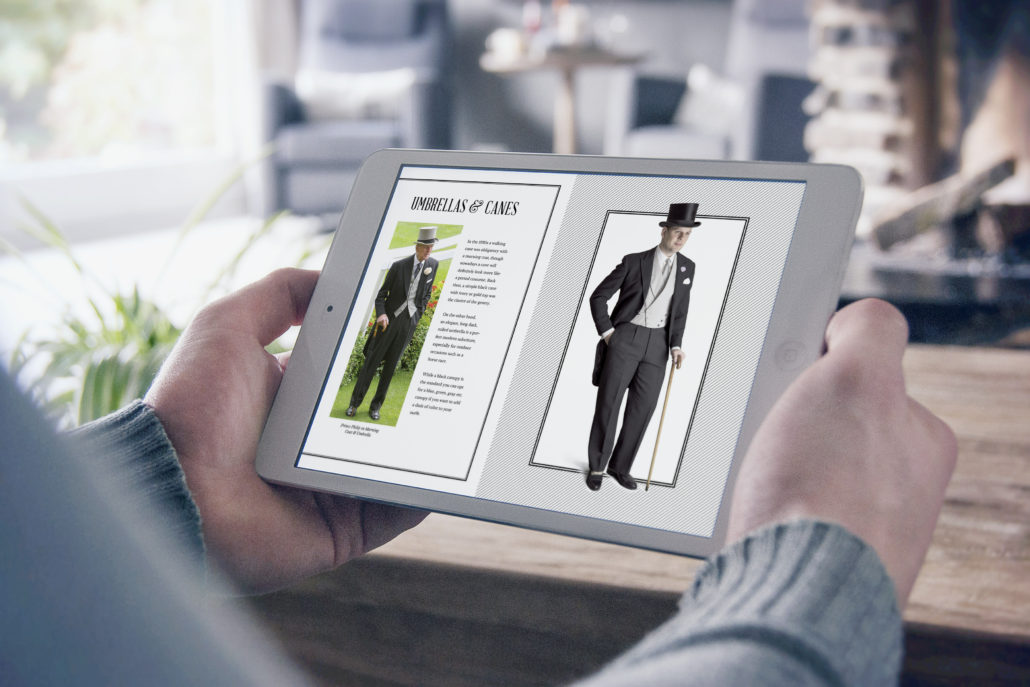
| 7. Accessories | · Cufflinks · Optional pocket watch and chain · Boutonniere such as rose or carnation for wedding · Debrett’s suggests pale unlined yellow gloves with black coat, unlined gray with gray coat · White linen pocket square · optional walking cane or, preferably, tightly rolled umbrella |
| Outerwear | Optional top hat (obligatory at Royal Ascot in the Royal Enclosure): · black silk is smarter than wool felt and more formal but only available vintage · gray wool felt with black band also acceptable, especially with grey morning coat |
Less Formal Morning Dress: The Morning Suit
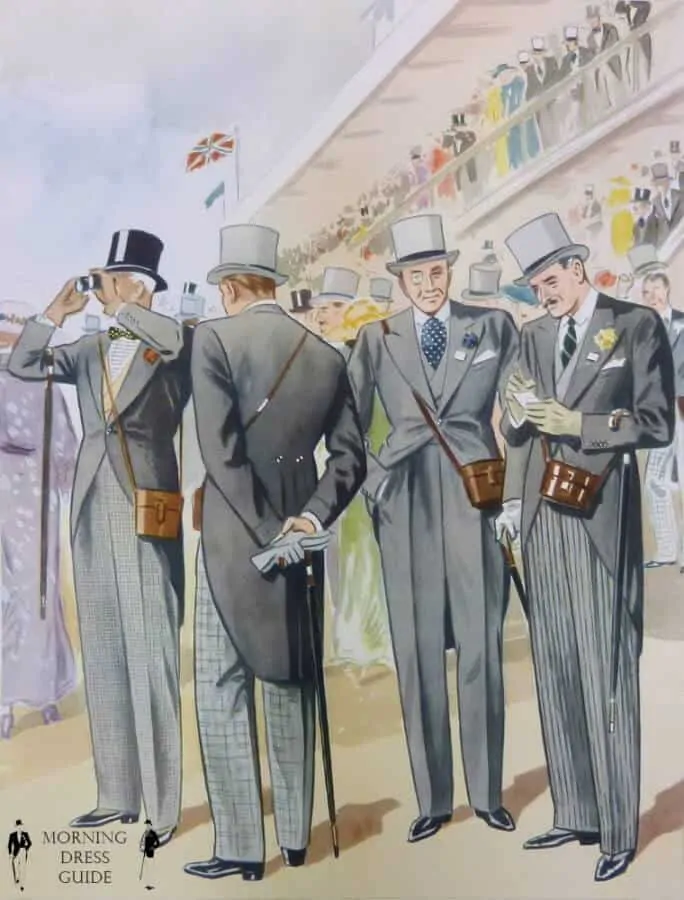
In Britain the morning suit is a less formal version of morning dress appropriate for races and summer weddings. This suit differs from formal morning dress only in that the cutaway, trousers and waistcoat are constructed from the same light or mid-gray material. Note that the term is often used as a synonym for morning dress although technically this is incorrect as only a jacket and trouser of matching fabric are by definition a “suit”. (The word is derived from the French suite which means “to follow” as in the trouser fabric following the precedent of the coat fabric.)
Overview of Semi-Formal Morning Dress
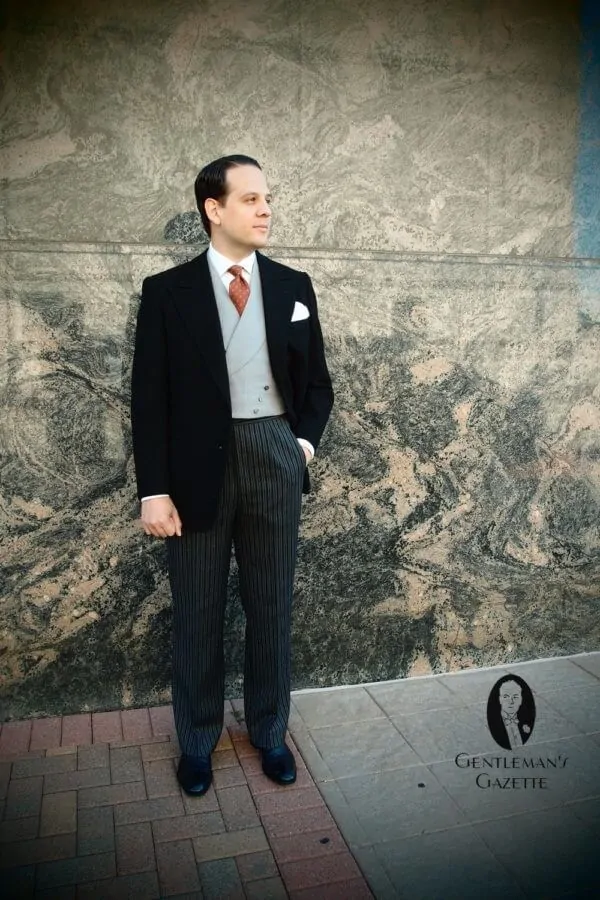
Just as the suit-like dinner jacket was an informal replacement for the evening tailcoat, the suit-like stroller (black lounge in UK) rose to popularity on both sides of the Atlantic in the 1920s as a less formal replacement for the morning tailcoat. But whereas the dinner jacket eventually supplanted the tailcoat as formal evening attire, the stroller faded into obscurity after World War Two leaving the morning coat as standard formal day wear. Although rarely seen today this alternative remains equally acceptable, and arguably more much more versatile.
| 1. jacket (Stroller / black lounge) | · suit-like jacket in black or charcoal · single- or double-breasted, single with one two buttons · peaked lapels only, notched is too informal · no vent or two side vents · besom pockets, no flap pockets |
| 2. Trousers | as per formal morning dress although there is more latitude for informal patterns |
| 3. Waistcoat | as per formal morning dress |
| 4. Shirt | as per formal turndown collar shirt |
| 5. Neckwear | as per formal four-in-hand ties |
| 6. Footwear | as per formal morning dress |
| 7. Accessories | as per formal morning dress |
| 8. Outerwear | optional black homburg or bowler hat |
sources: The Suit: A Machiavellian Approach to Men’s Style
Emily Post’s Etiquette (2004 edition)
A Well-Dressed Gentleman’s Pocket Guide
Debrett’s A-Z of Modern Manners
Men’s Style: The Thinking Man’s Guide to Dress
History of Men’s Fashion: What the Well-Dressed Man is Wearing
Mr. Jones’s Rules and The Indispensible Guide to Classic Men’s Clothing
How To Tie a Formal Ascot / Wedding Cravat
One should not confuse the dress ascot (dress cravat in UK) that ties outside a buttoned shirt collar with the ordinary ascot (cravat in UK) that ties inside an unbuttoned collar. If you insist on wearing a cravat then at least make sure it’s self-tied. You can find a classic selection of formal daywear dress ascots here. Watch the video above for instructions on tying a cravat the traditional way and with the modern ruche knot.
Formal Facts
Well Suited: The Waistcoat Must Cover The Waistband
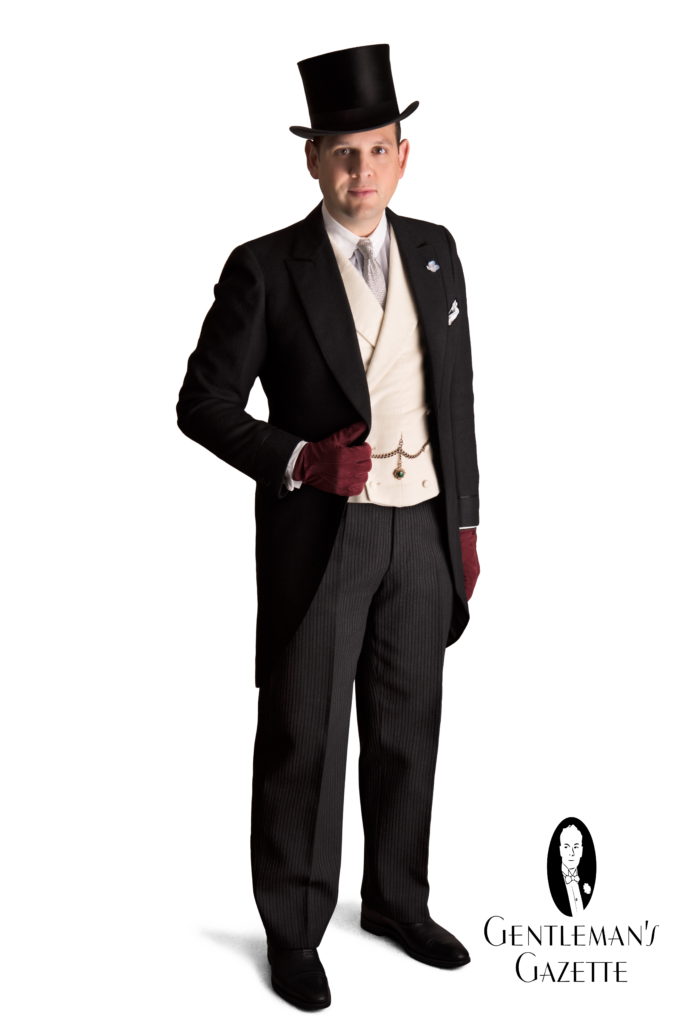
The waistcoat must be coordinated with the morning coat so that the former extends only slightly below and above the latter.
Morning Dress Around the World
Outside of the UK, morning dress is most likely to be seen in monarchies such as Luxembourg, the Netherlands, and Japan. In Germany the stroller is known as a Stresemann after the Chancellor who first popularized it in the mid 1920s. In some other countries it is known as a director’s jacket based on its traditional role as attire for members of corporate boards of directors.