|
|||||||||||||||||||||||||||||
|
Defining Classic Black
Tie
|
Classic Black-Tie Neckwear
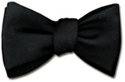
The formal bow tie is not just black tie’s namesake but also its pièce de résistance as it has come to embody the formality and elegance of the entire tuxedo ensemble. When a gentleman enters a room, it is the black bow shape framed against a crisp, white shirt that immediately sets his formal wear apart from a simple dark suit. In the tuxedo’s heyday formal bow ties were available in an almost infinite variety of shapes and sizes. Today the ready-to-wear options are much more limited and many of the classic variations will necessitate the services of a custom tailor or manufacturer.
• Model
Self-Tie versus Pre-Tied The choice of bowtie model separates the men from the boys - and the gentlemen from the waiters. A truly stylish dresser would no more consider wearing a pre-tied bow tie to a formal function than he would donning a clip-on four-in-hand tie for work. The decision to avoid self-tie models is invariably based on ignorance rather than experience: most men have no idea that the process is virtually identical to tying a simple shoelace bow. A fear of imperfection may also be a contributing factor but the fact of the matter is that a slightly asymmetrical bow adds a unique flair to each man’s ensemble. Just as the natural imperfection of a real flower trumps the perfection of an artificial boutonniere, the human touch of a hand-tied bow will always best the mechanical precision of a pre-tied fabrication.
Fixed Size versus Adjustable Adjustable models are the norm nowadays but
sized ties are preferable. The primary advantage of a fixed
length tie is that the width of the finished bow is designed to be
directly proportioned to a specific neck size as opposed to the
one-size-fits-all bow which is expected to accommodate necks ranging
from fourteen to eighteen inches in circumference. And
because the fitted models are made from a single piece of material,
their exposed bands forego the excess folded-over material and
unsightly metal buckles characteristic of the adjustable versions –
a particularly important factor for gentlemen with a preference for
wing collar shirts.
• Styles
The shape of one’s bow is a matter of personal preference although the pointed-end options coordinate nicely with the angularity of peaked lapels and wing collars.
The dotted lines shown on the above patterns indicate where the tie is folded to create the bow shape. In the case of pointed ties, the two points are achieved when the two blades are overlapped. (See Supplemental: How to Tie a Bow Tie for complete details regarding the tying process.)
Unlike its shape, the tie’s size must follow certain guidelines to ensure a handsome proportion. Originally the rule of thumb was that the outer edges of the bow never extended beyond the edges of the collar. However, since wing collars are now much smaller than they were, it is safer to use Alan Flusser’s rule that the finished bow should fall somewhere between the width of the wearer’s face and the outer edges of his eyes. In terms of tie width (i.e. the vertical
measurement of the tie ends), these tend to vary by bow style as
well as by current fashions.
The sizes used in the chart above are a good starting point
but by no means absolute. In general, wider ties work well
with higher collars as they prevent the bow from becoming
insignificant in comparison. • Placement
When worn with wing collars, bow ties are
traditionally placed in front of the wings because
the original collars were starched so
stiffly that it was
impossible to place their tabs over the bow. Etiquette aside,
this positioning is also the more practical choice as the collar’s
wings help to keep the bow in place by pressing it forward. • ColorThe term
“black tie” says it all. When it comes to classic tuxedo
neckwear, the only allowable color other than ebony is midnight blue
- and that’s solely because it is considered blacker than black.
Any other hue will “make you
look like you are nostalgic for the worst excesses of the 1980s” in
the words of menswear authority Nicholas Antongiavanni.
• Material
The texture of the bow is governed by the lapel
facing of the dinner jacket. A satin lapel calls for a satin
bow tie while grosgrain facings require a ribbed
or textured finish such as barathea. Like
the jacket lapels, a quality bow tie will always be constructed of
pure silk.
|
The quirky irregularities of a self-tied bow give it personality and flair . . .
. . . while the cookie-cutter precision of a pre-tied model diminishes it to an assembly-line commodity.
The unbroken band of the sized bow tie at top creates a much more sophisticated effect than the hooks and loops that break up the bands of the adjustable ties below it.
The effect of tie width on bow shape: The same tie pattern shown in 2½" and 2" sizes.
The bow tie's size must be proportionate to the wearer's face to avoid looking comical.
The many nuances of formal silk: Faille . . .
. . . grosgrain . . .
. . . barathea . . .
. . . and satin.
|
|||||||||||||||||||||||||||
| TOP OF PAGE |
UPDATES |
GLOSSARY |
SEARCH |
CONTACT AUTHOR
COMPARATIVE ENGLISH TERMINOLOGY Hover over images for picture credits. Copyright © 2008. Peter Marshall. All rights reserved. This site does not function correctly in Firefox |
|||||||||||||||||||||||||||||